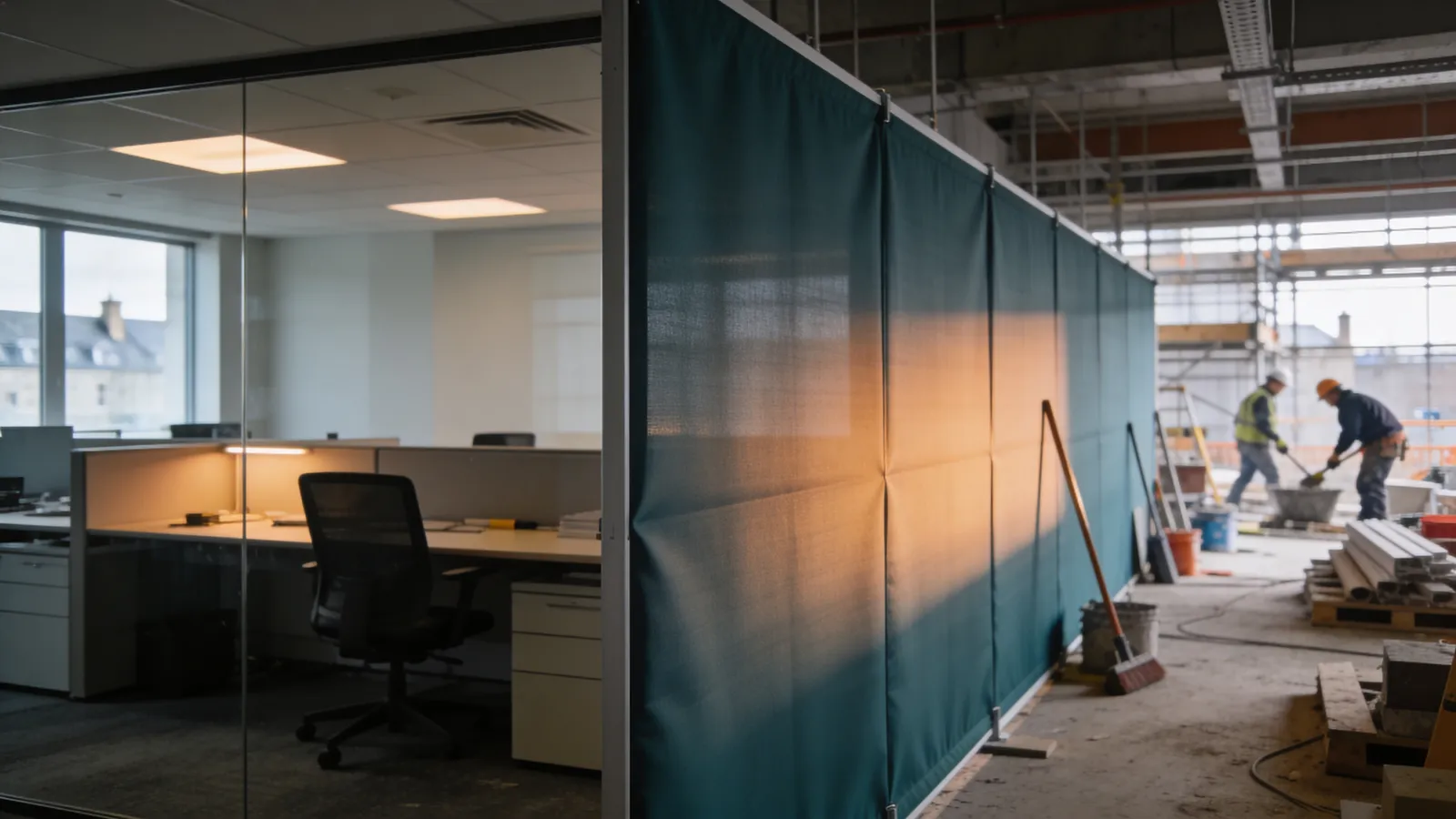
Most refurbishment work in Scotland does not happen in empty buildings. It happens while staff answer phones two floors down, while a care home keeps residents in their rooms, while a retail unit trades through the week and shuts only on a Sunday. The build has to carry on, but so does the business around it. That tension is where dust protection earns its place. Get it right and nobody downstairs notices the strip-out above them. Get it wrong and you spend the next week cleaning up complaints, sensitive equipment, and goodwill.
Dust is not just a tidiness problem. Silica dust from cutting concrete, screed, or sandstone is a genuine health hazard, and the HSE treats it seriously. On an occupied site you have a second audience to protect: the people who never agreed to be near the work. That raises the bar.
Why occupied sites change the rules
On an empty site you can let dust settle and clean at the end. On an occupied one, that approach fails on three fronts at once. People are breathing the air, sensitive equipment sits in adjacent rooms, and reputational damage spreads faster than the dust itself.
The practical consequences are specific:
- Shared air paths. Most commercial buildings share ductwork, risers, and ceiling voids. Dust generated in one zone travels through the HVAC system and reappears in offices nowhere near the work.
- Continuous occupation. You cannot wait for a quiet weekend if the building never empties. Containment has to hold during working hours, not just overnight.
- Vulnerable occupants. Care homes, clinics, schools, and food premises carry higher duties. A respiratory patient or an open kitchen changes what counts as acceptable.
- Live services. Fire alarms, smoke detectors, and clean rooms react badly to airborne particulate. A dusty corridor can trip a detector and evacuate the whole building.
These are not edge cases. They are the normal condition for fit-outs in occupied offices, hospitals, hotels, and listed buildings across Glasgow, Edinburgh, and Aberdeen.
Containment that actually holds
Good containment is layered, not a single sheet of polythene taped to a door frame. The aim is to keep dust inside the work zone and keep clean air moving the right way.
Start with physical separation. Temporary dust walls built from a rigid frame and sealed sheeting give you a proper barrier rather than a flapping curtain. Where access is needed, a zipped doorway or a two-stage airlock stops dust escaping every time someone walks through. Seal the often-forgotten gaps: ceiling voids, service penetrations, and the underside of raised floors all leak if you ignore them.
Then manage the air itself. Negative air pressure is the technique that separates a tidy job from a contained one. By running an extraction unit with a HEPA filter, you pull air out of the work zone faster than it leaks in, so the zone sits at slightly lower pressure than the occupied space. Air flows in, never out. A unit sized correctly should give you several air changes an hour and keep the barrier visibly drawn inward.
Capture dust at source as well. Tools fitted with on-tool extraction (an M-class or H-class vacuum connected to the cutting head) remove a large share of the particulate before it ever reaches the air. Wet cutting suppresses silica during concrete and masonry work. These methods do most of the heavy lifting; containment then handles the rest.
Planning the work around people
The cleverest barrier still fails if the schedule ignores the building's rhythm. Walk the site before the first sheet goes up and map who is where, and when.
A few questions shape the whole plan:
- When is the space genuinely empty? Even an occupied building has quieter windows. The dustiest tasks, breaking out, grinding, sanding, belong there.
- What can be isolated? Shutting down or rerouting the relevant HVAC zone during the work stops the ductwork carrying dust across the building.
- Where do people walk? Protected routes and clear signage keep occupants away from the boundary and away from the inevitable spillover at access points.
- How will you check it is working? A simple daily walkthrough of adjacent areas, plus dust monitoring on higher-risk jobs, tells you whether the containment is holding before anyone complains.
Communication matters as much as the kit. Tell the facilities manager and the affected tenants what is happening, when the loud or dusty phases fall, and who to call if something gets through. A five-minute heads-up prevents most disputes.
Cleaning down, not just sealing up
Containment buys you control during the work. The handover is where occupants form their judgement. A proper clean-down uses HEPA vacuums rather than brushes that throw dust back into the air, and it covers the surfaces people actually touch: desks, sills, vents, and floors. Wipe down before you strike the barriers, then again after, so removing the sheeting does not undo the work. On sensitive sites, a final air clearance check is worth the hour it takes.
This is the part of construction support that ORVO Group handles end to end, from setting up dust walls and negative air to the final clearance clean, so the trades can focus on building and the building can keep running.
Keeping the build contained
Dust protection on an occupied site is mostly planning, a bit of equipment, and the discipline to check the barrier is doing its job. Done well, it is invisible, which is exactly the point. If you are weighing up a refurbishment while the building stays in use, our construction support service can scope the containment and air management around your programme. To talk it through, get in touch.