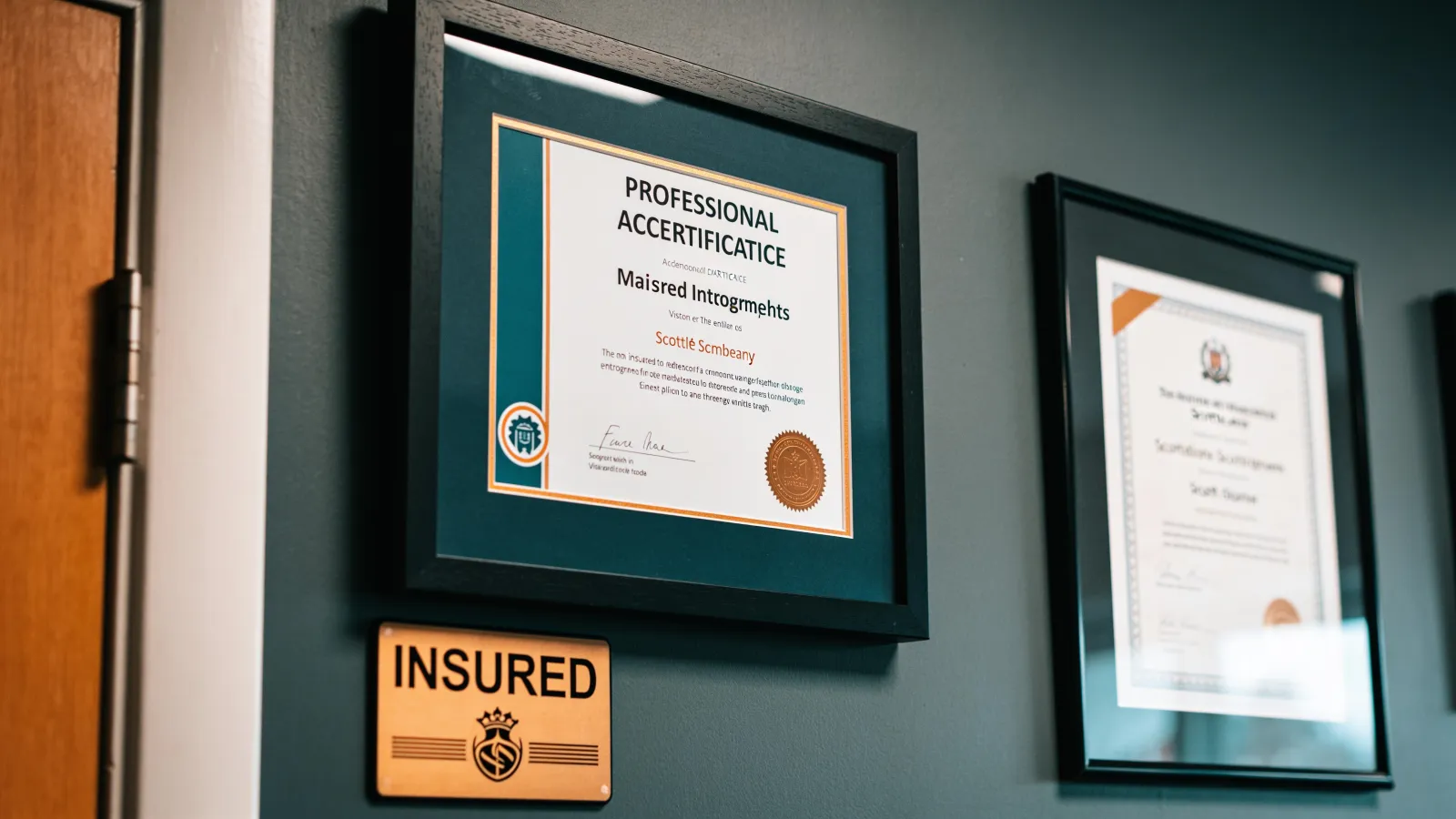
When you hire a contractor for cleaning, maintenance or facilities work, you will see two phrases on almost every website: "fully insured" and "SSIP accredited". They sound reassuring. The trouble is that both phrases are easy to print and harder to back up. If you manage a commercial property, factor a block of flats, or look after a portfolio of buildings, the gap between the claim and the paperwork is your risk to carry.
This guide explains what each term actually covers, what to ask for, and how to check it in a few minutes.
What "fully insured" really means
"Fully insured" is not a legal standard. It is a marketing phrase. What matters is which policies a contractor holds and the level of cover on each. For property and facilities work in Scotland, look for three in particular.
- Public liability insurance. This covers injury to third parties or damage to property caused by the contractor's work. For commercial sites, a cover level of 5 million pounds is common, and many landlords and managing agents now ask for 10 million as a contract condition.
- Employers' liability insurance. This is a legal requirement under the Employers' Liability (Compulsory Insurance) Act 1969 for almost any business with staff. The minimum required cover is 5 million pounds, though most policies are written at 10 million. If a contractor has employees and cannot show this, walk away.
- Professional indemnity insurance. This matters where advice or design is involved, for example specifying a repair, surveying, or recommending a remedial approach. If the work is purely physical, it may not apply, but for anything involving judgement it is worth checking.
Two practical points. First, cover levels matter as much as the policy itself. A contractor "with public liability" might hold only 1 million pounds, which is thin for commercial work. Second, policies lapse. A certificate from eight months ago tells you nothing about today. Ask for a current certificate of insurance with an expiry date you can read.
What SSIP accreditation actually is
SSIP stands for Safety Schemes in Procurement. It is an umbrella body that links a group of assessment schemes, the best known being CHAS, SafeContractor, Constructionline, SMAS and Acclaim. When a contractor holds one of these, an assessor has reviewed their health and safety arrangements against a recognised standard and judged them competent to manage the risks in their line of work.
The point of SSIP is mutual recognition. Rather than every buyer running their own health and safety questionnaire, one assessment is accepted across the scheme network. For you, an SSIP certificate is shorthand for "an independent assessor has checked this contractor's safety systems within the last year".
What it does not mean is worth stating plainly. SSIP confirms that documented health and safety arrangements meet a standard. It is not a guarantee that every job will be done safely, and it is not the same as insurance. The two are separate checks and you want both.
How to verify the claims in five minutes
Claims are cheap. Verification is quick if you know what to ask for. Before any contractor sets foot on your site, request the following.
- A current certificate of insurance for each relevant policy, showing the insurer, the cover level, and the expiry date.
- The contractor's SSIP certificate, showing the scheme name, the certificate number and the valid-to date.
- For higher-risk work, a method statement and risk assessment specific to your site, not a generic template.
Then check three things. Confirm the cover levels meet your contract requirement. Confirm both certificates are in date, not expired. And confirm the company name on the certificates matches the company you are actually contracting, which catches the common problem of a trading name that differs from the insured legal entity. Most SSIP schemes also let you confirm membership directly on their website if you want to be certain.
Why this matters for Scottish property owners
If something goes wrong on your property and the contractor's cover turns out to be lapsed, inadequate, or held by a different entity, the financial and legal exposure can land with you as the duty holder. Under the Construction (Design and Management) Regulations 2015, those commissioning construction-related work have defined duties to appoint competent people. Checking insurance and SSIP status is not box-ticking. It is part of meeting that duty.
This is one reason ORVO Group keeps current insurance and accreditation documents ready to share before work starts, rather than asking clients to chase for them afterwards.
Before you sign
The two phrases are a starting point, not proof. Ask for the certificates, read the cover levels and the dates, and match the names. Five minutes of checking now is far cheaper than a dispute later.
If you would like help reviewing a contractor's documents or setting clear requirements for your buildings, see our guidance service or get in touch and we will talk it through.